Phuket Old Town guide
Phuket Local Food Experience: What to Eat, Learn & Notice in Old Town
There is a difference between eating local dishes and understanding local food. Both are pleasures. The first fills an afternoon; the second changes how you taste the rest of your trip.
This guide is not a restaurant list. It is about what to notice when you eat in Phuket Old Town — the ingredients, the family knowledge behind a recipe, the traces of trade and migration — and why learning with your hands makes food memories last.
Eating local vs understanding food heritage
Ordering a well-known dish in a busy shop is a great start. Understanding food heritage means asking a few more questions. Why is this noodle used here? Which part of the dish is Southern Thai and which came through Chinese-Phuket families? Who taught the cook, and what have they changed?
You do not need a textbook for this. You need curiosity, a willingness to ask, and ideally someone local who can connect the plate to the place.
Ingredients tell the story
Phuket sits at a meeting point of Southern Thai cooking and Chinese-Phuket family traditions, shaped over time by trade and migration. You can taste those overlaps in the ingredients: local fruit and herbs, rice, seafood, and noodles such as Phuket Mee Sua.
It is tempting to label everything in Old Town as one cuisine. In reality, the food draws on several influences, and part of the enjoyment is noticing where they meet on a single plate.
Dishes worth understanding
These are the dishes we cook, taste and share on our own tour. They are examples, not a complete list of Phuket food:
- Phuket Pineapple Salad — a bright start to the table.
- Goong Sarong — prepared using Phuket Mee Sua.
- Southern Khao Yum — a southern rice-and-herb dish.
- Phuket Hokkien Noodles — a familiar Old Town lunch dish.
- Kluay Buat Chi — banana in coconut milk, a simple local dessert.
Family knowledge and living kitchens
Much of Phuket’s food knowledge lives in families rather than cookbooks. Recipes are adjusted by taste, season and memory. That is what makes local food living heritage: it keeps changing while remaining recognisably itself.
When you eat in a family-run shop, you are often tasting that continuity. Be patient, be polite, and if the cook has a moment, ask about the dish. Many are glad to share a little.
Learning by doing
Watching someone cook is interesting. Doing it yourself — slicing, mixing, tasting, adjusting — is what makes a dish stay with you. Even a small hands-on session changes how you order food for the rest of your trip.
Pair food with the town
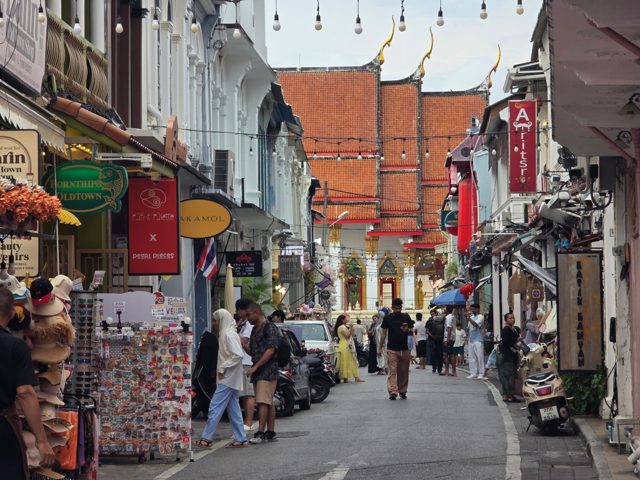
Food makes the most sense alongside the streets, shrines and shophouses around it. Our guide to things to do in Phuket Old Town suggests how to spend a slow half-day, and our Phuket Old Town food tour guide explains what to look for when choosing a guided food walk.
Practical notes on dietary needs
If you have allergies or dietary restrictions, tell your host in advance and ask how substitutions work. On our tour, substitutions depend on available ingredients and are confirmed before payment.